

The most effective non-drug alternatives to telehealth ED pills are targeted daily restoration routines, evidence-backed devices like Primal Red Co's RedRockit, and measurable lifestyle changes that together produce reliable gains in energy, drive, and sexual vitality. You don't need a prescription to start. You need a plan.
Here's where to begin right now:
- Sleep anchor: Set a fixed wake time and protect 7.5–8 hours. Improving sleep quality can increase testosterone in some men. That's not a supplement. That's free.
- Resistance training: Three sessions per week of 30 to 45 minutes each. This is the single most consistent lifestyle lever for testosterone support after 30.
- Red-light therapy: Daily 10–15 minute sessions with a targeted device like RedRockit, using guided protocols through the companion Rockit IQ app.
- Stress management: Ten minutes of breathwork or meditation each evening. Cortisol is the silent testosterone killer most men ignore.
Pro Tip: Don't try to change everything in week one. Pick one anchor habit, lock it in for seven days, then stack the next. Compounding beats intensity every time.
Table of Contents
- What are the best non-pharmaceutical alternatives to ED pills?
- How do these alternatives actually support energy, drive, and vitality?
- Your 30-day restoration plan: what to do before bigger decisions
- How to choose the right approach for your situation
- Key Takeaways
- What I actually think men get wrong about this
- RedRockit: the device built for this exact plan
What are the best non-pharmaceutical alternatives to ED pills?
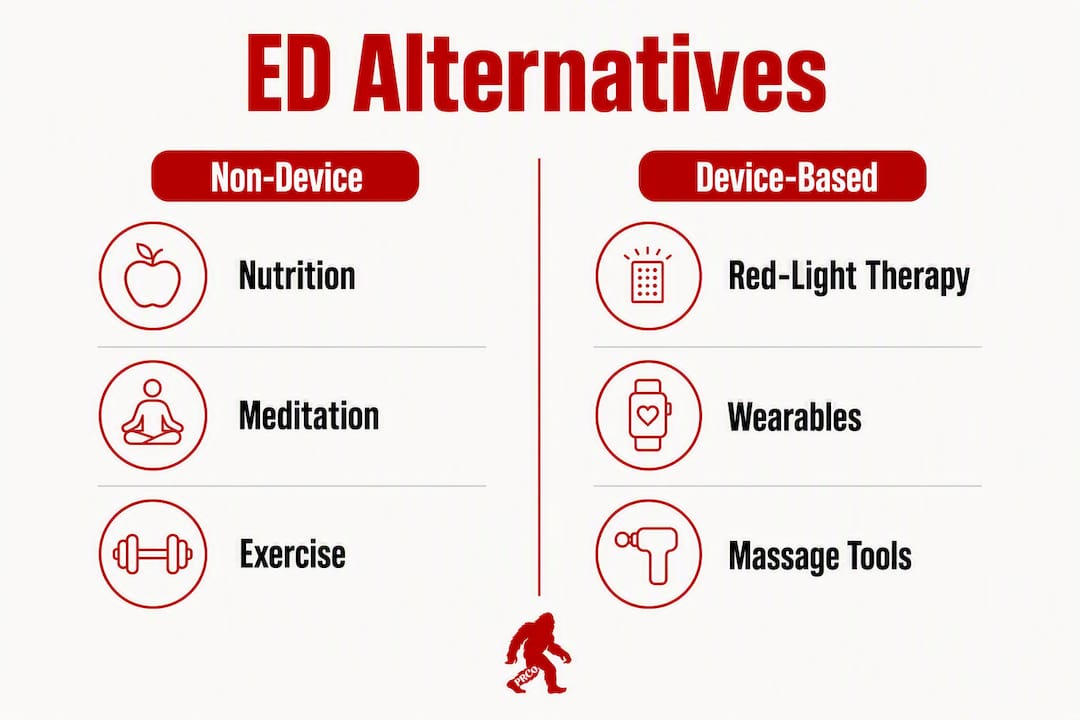
If you've been searching for BlueChew alternatives, you're probably not looking for another pill. You're looking for something that works with your body, not around it. Here's how the main non-drug options compare.

| Approach | Type | Evidence Level | Time to Effect | Daily Commitment | Typical Cost | Safety Notes | Best For |
|---|---|---|---|---|---|---|---|
| RedRockit (red-light device) | Device | Mechanistic + emerging clinical | 4–8 weeks | 10–15 min | One-time purchase | Avoid with photosensitizing meds; check with clinician if uncertain | Men wanting a daily, guided, device-based protocol |
| Sleep & circadian anchoring | Routine | Strong (hormonal) | 2–4 weeks | 30 min wind-down | Free | None | Men with fragmented sleep or low morning energy |
| Resistance training | Routine | Strong (testosterone, vascular) | 4–8 weeks | 45 min, 3x/week | $0–$20/month | Low; start light if deconditioned | Men with sedentary patterns |
| Targeted nutrition | Routine | Moderate–strong | 4–12 weeks | Meal planning | $20–$30/month | None for whole foods | Men with poor diet quality |
| Breathwork/stress protocols | Routine | Moderate (HRV, cortisol) | several weeks | 10 min/day | Free–$15/month app | None | Men with high stress, poor recovery |
Cost reality check: A one-time device purchase like RedRockit replaces the recurring monthly cost of coaching subscriptions, telehealth fees, or supplement stacks. Over 12 months, the math shifts significantly in favor of a device-first approach.
How do these alternatives actually support energy, drive, and vitality?
The signal didn't disappear. Your body just stopped sending it as loudly. Here's what's happening under the hood, and why each approach can move the needle.
Red-light therapy and mitochondrial energy
Photobiomodulation works by delivering specific wavelengths of light to tissue, where they interact with mitochondrial photoreceptors. The result: increased ATP production and modulation of nitric oxide pathways, both of which matter for cellular energy and vascular function. Research shows that 810 nm wavelengths produce the most marked improvement in energetic status without raising oxidative damage. Wavelength specificity is not a marketing claim. It's the mechanism. RedRockit is built around this principle, with guided Rockit IQ sessions that emphasize correct dosing over session length.
Sleep and the testosterone signal
Testosterone levels decline roughly 1% per year starting in the mid-30s for many men. Sleep is where the body does most of its hormonal repair. Fragmented or shortened sleep disrupts the HPTA axis, the system that tells your body to produce testosterone. Fix the sleep, and you restore the signal. Evidence-backed lifestyle strategies consistently rank sleep timing and quality as the primary lever for men over 30.
Resistance training and vascular function
Lifting heavy things tells your body it still needs to be strong. Resistance training stimulates testosterone production, improves insulin sensitivity, and supports nitric oxide pathways that drive blood flow. Three sessions per week is enough to see measurable change within several weeks.
"Doctors often recommend a trial of intense lifestyle changes for men with low testosterone before considering medications." — Harvard Health
Stress management and autonomic balance
Chronic stress keeps cortisol elevated, which directly suppresses testosterone production. Breathwork and meditation aren't soft options. They're tools for resetting your autonomic nervous system, shifting from sympathetic overdrive to parasympathetic recovery. Ten minutes a day is a real dose.
Safety note: Red-light therapy is generally well-tolerated, but avoid sessions if you take photosensitizing medications, have active cancers in the treatment area, or have implanted electronic devices. When in doubt, check with your clinician before starting.
Pro Tip: Consistency at 810 nm beats longer sessions at the wrong wavelength. MDPI research confirms that wavelength selection drives the outcome, not just exposure time.
Your 30-day restoration plan: what to do before bigger decisions
This isn't a crash program. It's a stacking protocol. Sustainable 12-month routines outperform intense 3-week programs for hormonal improvement. Start here.
- Week 1: Baseline and sleep anchor. Set a fixed wake time. Log your baseline: morning resting heart rate, subjective energy (1–10), and libido score. Download a free HRV app (HRV4Training or Elite HRV). No other changes yet.
- Week 2: Add resistance training and nutrition. Three sessions per week, compound lifts (squat, deadlift, press). Add protein to every meal (aim for 0.7–1g per pound of bodyweight). Cut alcohol to two or fewer drinks per week.
- Week 3: Add RedRockit sessions and HRV tracking. Begin daily 10–15 minute guided sessions using the Rockit IQ app. Track HRV each morning before getting up. Add 10 minutes of evening breathwork.
- Week 4: Optimize and measure. Compare week 4 HRV, deep sleep %, and subjective scores to week 1 baseline. Adjust session timing, sleep window, or training load based on what the data shows.
Daily checklist (busy schedule version):
- Morning sunlight exposure, 5–10 minutes outside
- Protein and healthy fat at breakfast
- Resistance session OR 20-minute walk (3x/week full session, other days walk)
- RedRockit session, 10–15 minutes (morning or evening, consistent timing)
- 10 minutes breathwork before bed
Progress metrics to track:
- HRV (leading indicator for recovery and hormonal resilience)
- Deep sleep percentage (via Oura Ring, Whoop, or free sleep app)
- Morning resting heart rate
- Subjective energy and libido scores (1–10, logged daily)
Practitioners recommend HRV and deep sleep percentage as reliable leading indicators for restoration progress. At 4 weeks, you're looking for trend direction, not transformation. At 8–12 weeks, measurable shifts in energy, recovery, and drive are realistic expectations.
How to choose the right approach for your situation
Not every option fits every man. Here's how to match the approach to your reality.
Decision checklist:
- Time: Less than 15 minutes per day available? Start with sleep anchoring and a RedRockit session. Both require minimal active time.
- Budget: One-time device cost vs. ongoing coaching or supplement subscriptions. Calculate 12-month total, not monthly price.
- Medical history: On any medications? Check for photosensitizing drug interactions before starting red-light therapy. Hormone changes in your 30s are real but modifiable with early action.
- Timeline: Expect several weeks for early signals and a few more weeks for meaningful change. If you need results in two weeks, manage expectations or see a clinician.
Red flags that warrant a clinician visit:
- Sudden onset of ED with no lifestyle explanation
- Painful erections
- Systemic symptoms: fatigue, depression, significant weight gain alongside sexual changes
- Symptoms that worsen despite 8–12 weeks of consistent lifestyle effort
- Any concern about low testosterone symptoms that feel beyond lifestyle territory
Common mistakes to avoid:
- Changing everything at once. You won't know what's working.
- Chasing quick fixes. The body doesn't respond to urgency. It responds to consistency.
- Skipping tracking. Without a baseline, you can't measure progress.
Pro Tip: If you're evaluating whether to try non-clinical options before TRT, read what to try before TRT first. Knowing what you're comparing against makes the decision cleaner.
Key Takeaways
Non-pharmaceutical restoration for men over 30 works best when foundational habits (sleep, training, nutrition, stress management) are stacked with a targeted daily device protocol like RedRockit, tracked with objective metrics over 4–12 weeks.
| Point | Details |
|---|---|
| Sleep is the highest-leverage habit | Improving sleep quality can increase testosterone in some men — no cost, no prescription. |
| Wavelength matters in red-light therapy | 810 nm produces the most marked mitochondrial energy improvement; correct dosing beats longer sessions. |
| Stack habits, don't swap them | Add one anchor habit per week; sustainable 12-month routines outperform intense short programs. |
| Track leading indicators | HRV and deep sleep percentage give early, objective feedback before subjective energy shifts are noticeable. |
| RedRockit fits the 30-day plan | Primal Red Co's RedRockit device integrates daily guided sessions via Rockit IQ, supporting the full restoration stack. |
What I actually think men get wrong about this
Most men searching for BlueChew alternatives are asking the wrong question. They're looking for a swap, something that does the same job with fewer side effects or no prescription required. That framing keeps them stuck in reactive mode.
The men who see real, lasting change aren't swapping one fix for another. They're rebuilding the conditions that made them feel like themselves in the first place. Sleep, training, stress management, and targeted device support aren't consolation prizes for men who can't get a prescription. They're the primary intervention. The pill was always the shortcut.
What I've seen consistently is that men who commit to a stacked protocol for 8–12 weeks don't just notice changes in drive and energy. They notice changes in mood, focus, confidence, and how they show up for the people around them. That's not a side effect. That's the point.
The other thing men underestimate is how fast the signal returns when you stop suppressing it. Poor sleep, chronic stress, and a sedentary lifestyle aren't just bad habits. They're active interference. Remove the interference, add targeted support, and the body remembers what it's supposed to do. Hormone changes in your 30s are real, but they are modifiable with early, consistent action. That window is open right now.
RedRockit: the device built for this exact plan
If you want one tool that fits directly into the 30-day protocol above, RedRockit is it. It's not a supplement. It's not a telehealth subscription. It's a private-use red-light wellness device designed specifically for men over 30 who want daily, guided restoration support without a clinic visit.

The Rockit IQ companion app walks you through each session, so you're not guessing at wavelength, timing, or placement. The device is built around the 810 nm wavelength range that the research points to for mitochondrial energy support. One device, one daily habit, guided from day one.
This is the non-clinical route. No exogenous testosterone. No recurring prescription fees. Just a device you own, a protocol you follow, and results you can track. If you're ready to stop waiting and start restoring, explore the RedRockit Activation Method and see how it fits your 30-day plan.
This article is for general educational purposes only and is not medical advice. Confirm any health decisions with a qualified clinician or your primary care provider.